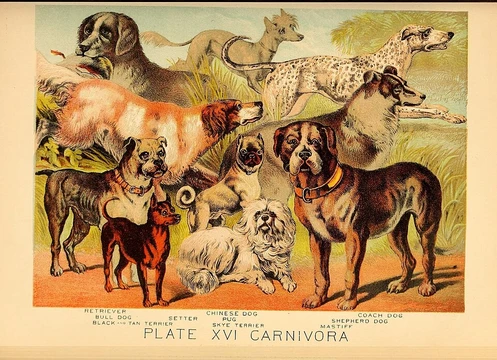
Australian Shepherd
Herding breed developed in California, popular as companion and sport dog.

via Wikipedia: Australian Shepherd · see source
The Australian Shepherd, also known as the Aussie, is a breed of herding dog from the United States. Despite the name, the breed was developed in California in the 19th century. It is believed to have its origins in sheepdog breeds from northwest Spain, as well as collies imported, alongside sheep, from Australia and New Zealand; the breed reportedly took its name from this trade. Originally used solely as a herding dog, the Australian Shepherd has become one of the most popular companion dog breeds in North America.
- origin
- United States (California, 19th century)
- height
- 18–23 inches (46–58 cm)
- weight
- 35–70 pounds (16–32 kg)
- coat
- Moderately long and wavy double coat; colors include blue merle, red merle, soli
- life_expectancy
- Median 13.7 years (2024 UK study)
- known_for
- Herding, dog sports, companion dog; ranked 12th most popular breed in the US (20
Lore & Background
The Australian Shepherd descends in part from pastoral dogs brought to herd Spanish flocks in North America as early as the 1500s. There is some speculation that these dogs included the Carea Leonés, a mountain sheepdog that can display the eye color and merle coat found in many contemporary Australian Shepherds. It is sometimes claimed that the Basque Shepherd Dog and the Pyrenean Sheepdog were also among the ancestors of the breed. The breed as it is known today developed in California in the 19th century, as a sheep herding dog for Californian shepherds. The Australian Shepherd is also believed to be descended from a variety of herding dogs imported to California with imported sheep, including collies from Australia and New Zealand. It was from these ancestors that the breed took its name. The Australian Shepherd spread from California throughout the Western United States where it became extremely popular with ranchers who valued the breed's sheep working qualities, as well as their ability to handle cattle and other livestock. A purely working breed for over a century, the Australian Shepherd was virtually unknown outside of the livestock industry until the mid-20th century when the breed was popularised by Jay Sisler, a rodeo performer, at rodeos across the western states with his Australian Shepherds performing all manner of tricks. A breed club was soon formed to promote the breed, the Australian Shepherd Club of America, and kennel club recognition followed in 1979 when the breed was recognised by the United Kennel Club. The breed was subsequently recognised by the American Kennel Club in the 1990s and later the Fédération Cynologique Internationale.
Reader's Guide
From the late-20th century the Australian Shepherd has increasingly been seen in conformation shows and it has become an extremely popular companion dog. In 2024 it was ranked by the American Kennel Club as the 12th most popular breed of dog in the United States. The Australian Shepherd is described as intelligent, active, loyal, protective, playful, and adaptive. The modern breed is predominantly bred for pets; despite this, many retain a strong herding instinct and it is not uncommon for companion dogs of the breed to try to herd children or other pets. A very active breed, the Australian Shepherd is known to become destructive if it does not receive adequate exercise. A 2024 UK study found a median life expectancy of 13.7 years based on a sample of 62 deaths. Based on a sample of 48 still-living dogs, the most common health concerns noted by owners were eye problems (red eye, epiphora, conjunctivitis, and cataracts). Dermatological and respiratory problems also ranked high. The Australian Shepherd is one of the more commonly affected breeds for an autosomal recessive mutation of the MDR1 gene. The breed shows relatively low levels (approximately 6%) of hip dysplasia. Double merles often have excessive light or white areas and can have hearing and vision problems as a result of having two copies of the merle gene. Like other herding breeds, these dogs excel at many dog sports, especially herding also known as stockdog, dog agility, dock diving/dock jumping, obedience, rally, tracking, disc, and flyball. An Australian shepherd named Pockets is credited as being the oldest dog to earn a title in AKC history, having earned the Rally Novice title at the age of 15 years, 5 weeks.
Did You Know?
- Despite its name, the Australian Shepherd was developed in California in the 19th century.
- The breed was virtually unknown outside the livestock industry until the mid-20th century, when rodeo performer Jay Sisler popularised it with his trick-performing dogs.
- An Australian Shepherd named Pockets is credited as the oldest dog to earn a title in AKC history, earning the Rally Novice title at age 15 years, 5 weeks.
- A 2024 UK study found a median life expectancy of 13.7 years for the breed, above the median of 12.7 years for purebreeds.
- The term 'lethal white' is a misnomer for double merle dogs; the genetic condition is not lethal, but breeders sometimes cull the pups.
Common Misconceptions (Editorial)
1. Despite its name, the Australian Shepherd did not originate in Australia; it was developed in California in the 19th century. 2. The term "lethal white" is a misnomer—the genetic condition associated with double merle dogs is not actually lethal, though breeders sometimes cull the pups. 3. The breed was virtually unknown outside the livestock industry until the mid-20th century, well after its development, and only became a popular companion dog later.
Why It Matters (Editorial)
The Australian Shepherd’s rise from an obscure herding tool to one of North America’s most beloved companion dogs reflects a broader cultural shift in how we value working breeds—not just for their utility, but for their intelligence, trainability, and loyalty. Its enduring appeal, boosted by rodeo performances and modern dog sports, shows how a breed’s history and versatility can keep it relevant across generations and changing lifestyles.
Frequently Asked Questions
Who is Australian Shepherd?
Australian Shepherd, commonly called the Aussie, is a herding dog breed that was actually developed in California during the 19th century, despite its misleading name. Its ancestry is believed to trace back to Spanish sheepdogs and collies that arrived in North America alongside sheep from Australia and New Zealand, which is where the breed borrowed its name.
What are Australian Shepherd's powers and role?
The Aussie is a natural herder, a competitive force in dog sports, and a deeply devoted family companion. It wears a moderately long, wavy double coat in blue merle, red merle, solid black, or solid red, often accented with white markings and tan points.
How does Australian Shepherd's story end?
A 2024 UK study pegged the breed's median lifespan at 13.7 years, giving owners more than a decade of companionship. As with most healthy herding breeds, the Aussie's story typically winds down gradually rather than abruptly.
Why is Australian Shepherd important to the dog world?
Ranked the 12th most popular breed in the United States as of 2024, the Aussie has outgrown its original single-purpose role as a livestock herder. It now anchors one of North America's most beloved companion-dog lineages, prized for versatility in both sport and everyday family life.
What is Australian Shepherd's physical build and size?
The Aussie stands between 18 and 23 inches at the shoulder and tips the scale anywhere from 35 to 70 pounds. Its frame is built for endurance, supporting a moderately long wavy double coat that comes in a range of solid and merle colorways.
More in Dog Breeds 1-22
Spotted an error? Know more?
This is a living reference — every entry is fact-audited, and reader corrections feed straight into our audit queue. Suggest an edit · See this site's audit record