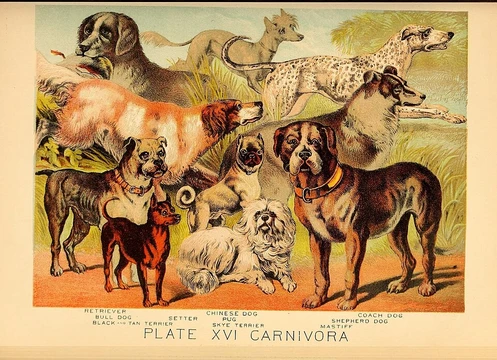
Bernese Mountain Dog
Large Swiss farm dog with tri-coloured coat and carting heritage.

via Wikipedia: Bernese Mountain Dog · see source
The Bernese Mountain Dog, German: Berner Sennenhund or Dürrbächler, is a large dog breed originating from the canton of Bern, Switzerland and the Swiss Alps. It is one of four Sennenhund-type breeds, with ancestral roots in Roman mastiffs. The name Berner (or Bernese in English) refers to the breed's area of origin in the canton of Bern, and Sennenhund is derived from the German Senne ("alpine pasture") and Hund ("hound/dog"), as they accompanied the alpine herders and dairymen called Senne. Historically used as a general farm dog, the large Sennenhunde also pulled carts as draft animals. The breed was formally recognized in 1912.
- Origin
- Canton of Bern, Switzerland and the Swiss Alps
- Breed group
- Working Group (AKC)
- Height (dogs)
- 64–70 cm at withers
- Height (bitches)
- 58–66 cm at withers
- Weight (dogs)
- 35–55 kg
- Weight (bitches)
- 35–45 kg
- Life expectancy
- 8–10.1 years (varies by study)
Verified Timeline
Lore & Background
Historically, in some locales at least, the breed was called a Dürrbachhund or Dürrbächler, for a small town (Dürrbach) where the large dogs were especially frequent. The dogs have roots in the Roman mastiffs. The breed was used as an all-purpose farm dog for guarding property and to drive dairy cattle long distances from the farm to the alpine pastures. The farmers used the dogs to transport their carts of milk and cheese and were known by the locals as "Cheese Dogs." In the early 1900s, fanciers exhibited the few examples of the large dogs at shows in Bern, and in 1907 a few breeders from the Burgdorf region founded the first breed club, the Schweizerischer Dürrbach-Klub, and wrote the first Standard which defined the dogs as a separate breed. By 1910, there were already 107 registered members of the breed. There is a photo of a working Bernese Mountain Dog, dated 1905 at the Fumee Fall rest area in Quinnesec, Michigan.
Reader's Guide
The Bernese Mountain Dog is a large, heavy dog with a distinctive tri-coloured coat, black with white chest and rust-coloured markings. It is the only breed of Sennenhund dogs with a long coat. The breed has a high frequency of neoplasia; one study found 55% of deaths to be attributable to cancer. It has a high prevalence of elbow dysplasia, with studies ranging from a prevalence of 13.91% to 26%. The breed has a high risk of developing high-grade mastocytoma, with an Austrian study finding Bernese Mountain Dogs being three times as likely to have the condition than the general population. Malignant histiocytosis accounts for a quarter of all tumours in the breed. The Bernese Mountain Dog is one of the more commonly affected breeds for type I von Willebrand's disease. Life expectancy varies by study: a 2016 Swiss study found 8.4 years, a 2013 Dutch study found 8 years, a 2024 UK study found 10.1 years, and a 2013 French study found 8.1 years. The breed's calm temperament makes them a natural for pulling small carts or wagons, a task they originally performed in Switzerland. On July 1, 2010, the Bernese Mountain Dog became eligible to compete in AKC Herding Events.
Did You Know?
- The breed was historically known by locals as 'Cheese Dogs' because farmers used them to transport carts of milk and cheese.
- In 1907, breeders from the Burgdorf region founded the first breed club, the Schweizerischer Dürrbach-Klub, and wrote the first breed Standard.
- By 1910, there were already 107 registered members of the breed.
- A 2024 UK study found a life expectancy of 10.1 years for the breed, compared to 12 years for crossbreeds and 12.7 years for purebreds.
- The Bernese Mountain Dog is the only Sennenhund breed with a long coat.
Common Misconceptions (Editorial)
- Some may think the breed’s name "Bernese Mountain Dog" refers to a mountain-dwelling origin, but the name actually comes from the canton of Bern in Switzerland, and the breed was historically used as an all-purpose farm dog and draft animal, not a mountain dog in the modern sense. - People might assume "Dürrbächler" is a separate or unrelated breed, but it is an alternate historical name for the Bernese Mountain Dog itself, derived from a small town where the dogs were especially common. - It is a common misconception that the breed was primarily a herding dog; in fact, while they did drive dairy cattle, they were general farm dogs that guarded property and pulled carts of milk and cheese.
Why It Matters (Editorial)
The Bernese Mountain Dog endures as a beloved breed because it embodies a rare blend of strength, gentleness, and utility—a working dog that was both a draft animal and a family companion on Swiss farms. Its history as the “Cheese Dog” of the Alps reminds us of the deep bond between humans and dogs in agricultural life, while its relatively short lifespan underscores the importance of responsible breeding and health research to preserve this iconic breed for future generations.
Frequently Asked Questions
Who is Bernese Mountain Dog?
A large, tri-coloured farm dog from the Swiss Alps around the canton of Bern, with ancestral ties to Roman mastiffs. In the encyclopedia it is catalogued as entry 1-22 and sits in the Working Group. It is one of four breeds in the Sennenhund family.
What are Bernese Mountain Dog's powers/role?
On Swiss mountain farms it served as an all-purpose worker—herding livestock, guarding property, and hauling carts as a draft animal. Its considerable size and pulling strength made it a true workhorse before the breed was formally standardized.
How does Bernese Mountain Dog's story end?
Its modern chapter kicked off in 1912, when the breed received formal recognition and a defined standard. Today the carting role has largely faded, but the dog continues to thrive as a companion and occasional working dog, keeping its Alpine heritage alive.
Why is Bernese Mountain Dog important?
It embodies centuries of Swiss Alpine farming tradition and is one of only four Sennenhund-type breeds that survived into the modern era. Preserving the breed helped retain a tangible piece of rural Swiss heritage that mechanization threatened to erase.
What are Bernese Mountain Dog's stats?
Males stand 64–70 cm at the withers and weigh 35–55 kg; females measure 58–66 cm and weigh 35–45 kg. Its signature look is a black base coat accented with rust and white markings, producing the unmistakable tri-colour pattern fans recognise instantly.
More in Dog Breeds 1-22
Spotted an error? Know more?
This is a living reference — every entry is fact-audited, and reader corrections feed straight into our audit queue. Suggest an edit · See this site's audit record