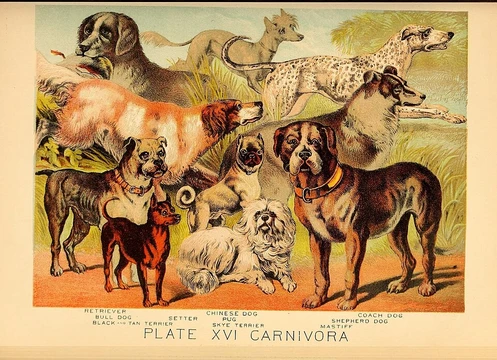
Border Collie
A British herding breed from the Anglo-Scottish border.

via Wikipedia: Border Collie · see source
The Border Collie is a breed of British herding dog of the collie type of medium size. It originates in the region of the Anglo-Scottish border, and descends from the traditional sheepdogs once found all over the British Isles. It is kept predominantly as a sheep-herding dog or as a companion animal. It competes with success in sheepdog trials. Some have claimed that it is the most intelligent breed of dog.
- origin
- Anglo-Scottish border region
- type
- Herding dog
- primary use
- Sheep-herding dog or companion animal
- notable ancestor
- Old Hemp (born September 1893, died May 1901)
- first named
- 1915 by James Reid, Secretary of the International Sheep Dog Society
- life expectancy
- 12.1 years (2022 UK study); 13.1 years (2024 UK study)
Verified Timeline
Lore & Background
The Border Collie is descended from landrace collies, a type found widely in the British Isles. The name for the breed came from its probable place of origin along the Anglo-Scottish border. Mention of the 'collie' or 'Colley' type first appeared toward the end of the 19th century, although the word 'collie' is older than this and has its origin in the Scots language. It is also thought that the word 'collie' comes from the old Celtic word for useful. Many Border Collies today can be traced back to a dog known as Old Hemp. Old Hemp, a tricolour dog, was born in Northumberland, England in September 1893 and died in May 1901. He was bred by Adam Telfer from Roy, a black and tan dog, and Meg, a black-coated, strong-eyed dog. Hemp was a quiet, powerful dog to which sheep responded easily. Many shepherds used him for stud and Hemp's working style became the Border Collie style. All purebred Border Collies alive today can trace an ancestral line back to Old Hemp. He was believed to have sired as many as 200 pups over the span of his life. Wiston Cap (b. 28 September 1963) is the dog that the International Sheep Dog Society (ISDS) badge portrays in the characteristic Border Collie herding pose. He was a popular stud dog in the history of the breed, and his bloodline can be seen in most bloodlines of the modern-day collie. Bred by W. S. Hetherington and trained and handled by John Richardson, Cap was a biddable and good-natured dog. His bloodlines all trace back to the early registered dogs of the studbook, and to J. M. Wilson's Cap, whose name occurs 16 times within seven generations in his pedigree. Wiston Cap sired three Supreme Champions and is grand-sire of three others, one of whom was E. W. Edwards' Bill, who won the championship twice.
Reader's Guide
The Border Collie is kept predominantly as a sheep-herding dog or as a companion animal, and competes with success in sheepdog trials. In 1915, James Reid, Secretary of the International Sheep Dog Society (ISDS) in the United Kingdom first used the term 'border collie' to distinguish those dogs registered by the ISDS from the Kennel Club's collie (or Scotch Collie, including the Rough Collie and Smooth Collie) which originally came from the same working stock but had developed a different, standardised appearance following introduction to the show ring in 1860 and mixture with different breeds. Collies were listed as imports to New Zealand as early as 1858, but the type was not specified. In the late 1890s James Lilico (1861?–1945) of Christchurch, New Zealand, imported a number of working dogs from the United Kingdom. These included Hindhope Jed, a black, tan and white born in Hindhope, Scotland in 1895, as well as Maudie, Moss of Ancrum, Ness and Old Bob. In 1901 the King and Mcleod stud brought Hindhope Jed to Australia, where she enjoyed considerable success at sheepdog trials. The New Zealand Heading Dog breed was developed from Border Collies. Health concerns include collie eye anomaly, two types of hearing loss (congenital sensorineural deafness and adult-onset hearing loss), neuronal ceroid lipofuscinosis (NCL), and trapped neutrophil syndrome (TNS), for which DNA tests are available. A syndrome of exercise-induced collapse, termed Border Collie Collapse, has been described in Border Collies in North America, Europe and Australia.
Did You Know?
- Old Hemp, born in September 1893 in Northumberland, England, is believed to have sired as many as 200 pups over his life, and all purebred Border Collies alive today can trace an ancestral line back to him.
- Wiston Cap, born 28 September 1963, is the dog portrayed on the International Sheep Dog Society (ISDS) badge in the characteristic Border Collie herding pose.
- The term 'border collie' was first used in 1915 by James Reid, Secretary of the ISDS, to distinguish working dogs from show-bred collies.
- Hindhope Jed, a black, tan and white dog born in Scotland in 1895, was considered the 'best to cross the equator' and won three trials in Scotland before being imported to New Zealand and later Australia.
- A 2024 UK study found a life expectancy of 13.1 years for the Border Collie, compared to an average of 12.7 for purebreeds and 12 for crossbreeds.
Common Misconceptions (Editorial)
Some people believe the Border Collie is a modern breed developed solely in the 20th century, but the breed's ancestors—landrace collies—were found widely across the British Isles long before the first use of the name "border collie" in 1915. Others may think the breed's history is scattered or without a single foundational dog, yet the facts show that all purebred Border Collies alive today can trace an ancestral line back to Old Hemp, born in 1893.
Why It Matters (Editorial)
The Border Collie endures not just as a beloved companion but as a living link to centuries of British pastoral tradition, with its working style still defined by dogs from over a century ago. Its remarkable intelligence and adaptability keep it relevant in modern contexts, from competitive sheepdog trials to homes worldwide, proving that a breed bred for function can remain timeless in both purpose and appeal.
Frequently Asked Questions
Who is Border Collie?
A medium-sized British herding dog that hails from the borderlands between England and Scotland. It belongs to the collie family and traces its lineage back to the working sheepdogs that roamed the British Isles for centuries.
What are Border Collie's powers/role?
This breed is renowned for its extraordinary herding ability and is regularly used to drive and manage flocks of sheep. It also excels in competitive sheepdog trials, where its instinct to control livestock is put on display.
What's Border Collie's origin story?
The breed's modern identity was shaped by a famous working dog named Old Hemp, who was born in 1893 and died in 1901. The name "Border Collie" itself was coined in 1915 by James Reid, Secretary of the International Sheep Dog Society, to distinguish these border-region dogs from other collie types.
How does Border Collie's story end?
On average, a Border Collie can be expected to live around twelve to thirteen years, according to recent UK longevity studies from 2022 and 2024. This places it in the mid-range for medium-sized working breeds.
Why is Border Collie important?
It is frequently cited as the most intelligent dog breed, a claim that stems from its remarkable problem-solving skills and trainability. Beyond the intelligence debate, it holds a central place in British agricultural history as the go-to working dog for managing livestock.
More in Dog Breeds 1-22
Spotted an error? Know more?
This is a living reference — every entry is fact-audited, and reader corrections feed straight into our audit queue. Suggest an edit · See this site's audit record