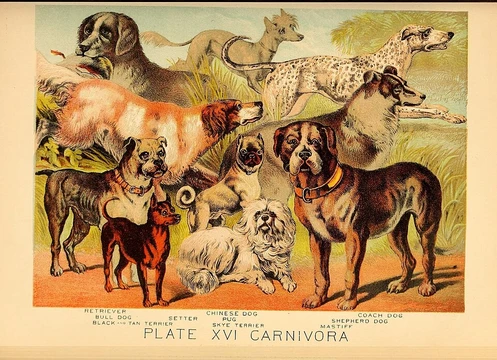
Doberman
German working dog bred for protection and loyalty.

It is known for its intelligence, alertness, and tenacious loyalty, and is kept as a guard dog or companion animal. In Canada and the United States it is called the Doberman Pinscher.
- Breed origin
- Germany
- Breeder
- Karl Friedrich Louis Dobermann
- Breed type
- Working dog of pinscher type
- Height (male)
- 68–72 cm at withers
- Weight (male)
- 40–45 kg
- Known for
- Intelligence, loyalty, guard dog ability
Lore & Background
Dobermanns were first bred in the 1880s by Karl Friedrich Louis Dobermann, a tax collector who ran a dog pound in Apolda in present-day Thuringia in central Germany. With access to dogs of many breeds, he aimed to create a breed ideal for protecting him, seeking impressive stamina, strength, and intelligence. Five years after Dobermann's death, Otto Goeller, one of the earliest breeders, created the National Doberman Pinscher Club and is considered to have perfected the breed, breeding and refining them in the 1890s. The breed is believed to have been created from several different breeds, though exact ratios and breeds remain uncertain. Many experts think it combines the Beauceron, German Pinscher, Rottweiler, and Weimaraner, with documented crossings with the Greyhound and Manchester Terrier. The old German Shepherd is widely believed to be the single largest contributor. During World War II, the United States Marine Corps used the Doberman Pinscher, alongside the German Shepherd, as war dogs.
Reader's Guide
The Dobermann's significance lies in its dual role as a working guard dog and a loyal companion, a legacy of its creator's original intent. Its intelligence has been consistently ranked among the highest in experimental studies and expert evaluations, with psychologist Stanley Coren ranking it 5th in obedience command training and other studies placing it first in trainability. The breed's temperament is complex: while often stereotyped as ferocious, scientific studies show it ranks high in stranger-directed aggression but extremely low in owner-directed aggression. Its physical characteristics, including a long muzzle and even gait, have been shaped by breeding for protection, with males typically muscular and intimidating. The breed's color variations—black, red, blue, and fawn—result from two genes, with the fawn being least common. Controversies around ear cropping and tail docking, now illegal in many countries, reflect changing ethical standards. The Dobermann's legacy is preserved through breed clubs and continued registration, though its numbers are modest compared to other breeds.
Did You Know?
- The breed is believed to combine several breeds including the Beauceron, German Pinscher, Rottweiler, and Weimaraner, with documented crossings with the Greyhound and Manchester Terrier.
- During World War II, the United States Marine Corps used the Doberman Pinscher as war dogs.
Common Misconceptions (Editorial)
- It is not true that the Doberman breed name is always "Doberman Pinscher"; that name is used only in Canada and the United States, while elsewhere it is called simply the Doberman. - The breed was not created by a professional dog breeder or scientist, but by a tax collector named Karl Friedrich Louis Dobermann, who ran a dog pound and selectively bred dogs for his own protection.
Why It Matters (Editorial)
The Doberman endures because it embodies a rare combination of sharp intelligence, fearless vigilance, and deep loyalty, making it a trusted protector and companion. Its origins in 19th-century Germany, driven by a tax collector’s practical need for safety, remind us that our most cherished dog breeds often arise from humble, human-centered purposes rather than pure aesthetics.
Frequently Asked Questions
What role is the Doberman best suited for?
It serves primarily as a guard and protection dog while also excelling as a devoted companion. Its pinscher-type working classification reflects a heritage built on alertness, tenacity, and sharp intelligence.
How big is a male Doberman?
Males measure between 68 and 72 cm at the withers and carry roughly 40 to 45 kg of weight. That places them squarely in the medium-large range among working breeds.
Why do fans regard the Doberman as such an important breed?
Its rare blend of high intelligence, unwavering loyalty, and protective instinct makes it one of the most versatile working dogs ever developed. It has become a lasting symbol of the ideal guard-and-companion pairing.
Why is the breed called 'Doberman Pinscher' in some countries?
In the United States and Canada the full name Doberman Pinscher is the standard designation, while elsewhere it is simply known as the Dobermann. The added 'Pinscher' simply highlights its place within the pinscher-type working group.
More in Dog Breeds 1-22
Spotted an error? Know more?
This is a living reference — every entry is fact-audited, and reader corrections feed straight into our audit queue. Suggest an edit · See this site's audit record