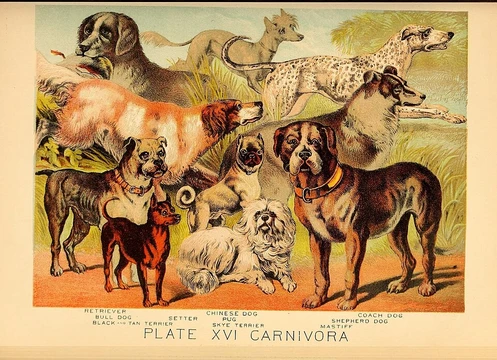
Pug
A sociable, gentle companion breed with ancient Chinese origins.

The Pug is a breed of dog with physically distinctive features including a wrinkly, short-muzzled face and curled tail. Originating in China, Pugs were brought to Europe in the sixteenth century and popularized by the House of Orange and the House of Stuart, later gaining royal favor in the United Kingdom under Queen Victoria. Known for being sociable and gentle companion dogs, Pugs remain popular into the twenty-first century.
- Origin
- China
- Introduced to Europe
- 16th century
- Coat colors
- Fawn, apricot fawn, silver fawn, black
- Temperament
- Even-tempered, charming, sociable, gentle
- Known for
- Companion dog, royal patronage
- Breed group
- Companion
Lore & Background
The ancestor of the Pug was the Lo-Chiang-Sze or Lo-Sze, a short-legged, short-mouthed, short-coated dog popular in the imperial court during the Song dynasty. Pugs were brought from China to Europe in the sixteenth century by the Dutch East India Company. In the nineteenth century, Queen Victoria developed a passion for Pugs, breeding them herself and passing this interest to other royal family members. These dogs had shorter legs and the modern-style Pug nose. Two notable British strains emerged: the Morrison line (cobbier, shorter-muzzled, richer yellow fawn) and the Willoughby line (stone fawn with excess black on the head).
Reader's Guide
The Pug's significance lies in its long history as a companion animal, bred primarily for that role rather than for hunting, herding, or guarding. Its popularity across centuries—from Chinese imperial courts to European royalty and modern celebrity owners—demonstrates its enduring appeal. The breed's physical traits, including its short muzzle, wrinkled face, and curled tail, are distinctive and have been selectively maintained. However, these bred traits also make Pugs susceptible to various health problems. The breed's temperament, described by the American Kennel Club as 'even-tempered and charming,' and its tendency to be intuitive and eager to please, have cemented its place as a beloved companion. The etymology of the name 'Pug' remains uncertain, with theories linking it to the marmoset monkey, the Latin 'pugnus' meaning 'fist,' or an obsolete term of endearment. The breed's motto, 'multum in parvo' ('much in little'), reflects its compact yet substantial presence.
Did You Know?
- The name 'Pug' may derive from the marmoset monkey, which was called a 'Pug-monkey' in the 18th century.
- Queen Victoria bred Pugs herself, including dogs named Olga, Pedro, Minka, Fatima, and Venus.
- The so-called 'prince mark' is a set of wrinkles on a Pug's forehead resembling the Chinese character for prince (王).
Common Misconceptions (Editorial)
- Some people believe Pugs originated in Europe or were naturally developed there, but they actually originated in China and were brought to Europe in the sixteenth century. - Another misconception is that Pugs have always had their modern appearance; in fact, the shorter legs and modern-style nose were developed in the nineteenth century under Queen Victoria’s influence.
Why It Matters (Editorial)
The Pug endures as a beloved companion because its history is entwined with royalty and empire, from Chinese imperial courts to the House of Orange and Queen Victoria’s own kennels. Its distinctive, almost comical appearance and gentle temperament have made it a symbol of affectionate loyalty across centuries, proving that charm and adaptability matter more than size or pedigree.
Frequently Asked Questions
What is a Pug?
The Pug is a small companion breed recognized for its wrinkly, short-muzzled face and tightly curled tail. It belongs to the companion breed group and has been kept as a gentle household pet for centuries.
Where did the Pug originate?
Pugs trace their roots back to ancient China. They were carried to Europe during the sixteenth century, where they quickly caught the attention of aristocratic families.
What colors can a Pug's coat come in?
The breed standard recognizes fawn, apricot fawn, silver fawn, and black as acceptable coat colors. All Pugs also display a characteristic black mask across the muzzle.
What is a Pug's temperament like?
Pugs are described as even-tempered, charming, and highly sociable dogs. They are gentle companions that bond closely with people and thrive in family settings.
Why were Pugs linked to European royalty?
The House of Orange and the House of Stuart helped popularize the breed across Europe, and Queen Victoria later gave it royal favor in the United Kingdom. This centuries-long association with nobility cemented the Pug's image as a distinguished companion dog.
More in Dog Breeds 1-22
Spotted an error? Know more?
This is a living reference — every entry is fact-audited, and reader corrections feed straight into our audit queue. Suggest an edit · See this site's audit record